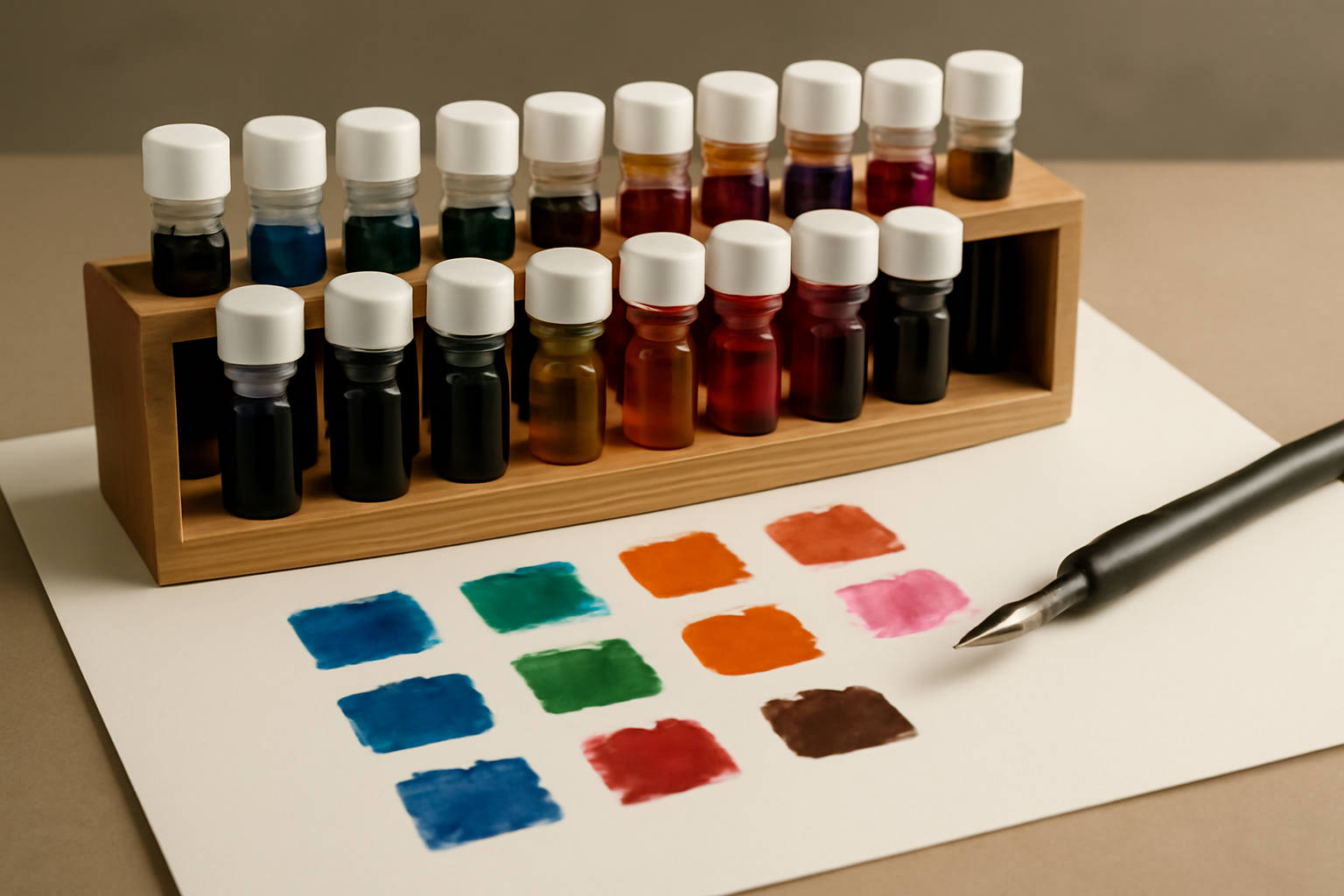
Here’s the myth I want to dismantle right away: that a swatch photo tells you anything reliable about how an ink will actually behave in your hand. It doesn’t. A few years into this hobby, I dropped money on a full 50ml bottle of a heavily praised ink purely because the online swatch showed a gorgeous deep teal. On my own paper, with my own nib, that same ink bled through like watercolor soaking a paper towel, and the shading turned blotchy rather than elegant. The bottle sat unused in my cabinet for two years before I finally gave it away. That single expensive lesson is the whole reason fountain pen ink samples reshaped how I collect, and it’s why I want to lay out exactly how I now put fifty-plus inks through their paces every year without stacking up a shelf of regrets.
Watches taught me this discipline long before ink did. Ten years spent handling everything from a $15 Seiko SNK809 up to a vintage Omega Seamaster running a caliber 552 movement made one thing clear: you have to live with a piece before you can trust your opinion of it. Ink follows the same rule. Color, flow, dry time, shading, sheen, water resistance — not one of these qualities shows itself honestly in a product photo. They only surface on real paper, under a real nib, in your actual hand.
What follows is my complete approach to using ink sample services with intention rather than impulse. I’ll cover where I get my samples, the method I use to judge them, the qualities I look for beyond simple color, and which inks eventually earned a permanent spot on my desk. Whether you’re brand new to fountain pens or a longtime collector trying to tighten up your process, this should spare you both wasted money and a cluttered ink cabinet.
Defining Fountain Pen Ink Samples — and Why They’re Worth the Trouble
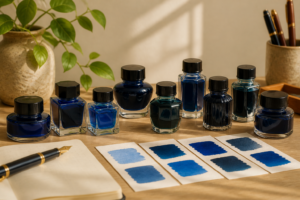
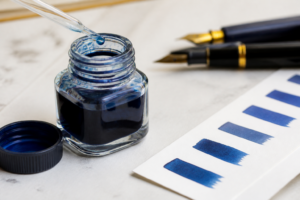
An ink sample, in practice, is a small sealed vial holding somewhere between 2ml and 5ml. Dedicated retailers — Goulet Pens, Vanness Pens, Anderson Pens among them — typically price these individually between $1.50 and $3.50. Do the arithmetic and you can put twenty different inks through testing for under $50 total, shipping included. Set that against buying twenty full 30ml-to-80ml bottles at $15 to $28 apiece, and the difference isn’t subtle at all.
Cost aside, samples solve something no review blog, however thorough, ever can: your particular setup is not anyone else’s. A medium Pilot nib gliding over Rhodia 80gsm paper produces a completely different result than a broad TWSBI nib scratching across a cheap composition notebook. Shading inks look breathtaking with a wet, broad nib and nearly flat with a fine, dry one. Something like Sailor Kiwa-Guro, praised for water resistance, can feel gummy and thick in a narrow nib. The only honest answer comes from testing it in your own pen.
Samples have also kept me from chasing every new release. The community’s enthusiasm for a fresh ink launch is genuine, and I understand it — but hype and personal compatibility are two separate things. Most years I skip three or four “must-buy” inks entirely, simply because the sample vial made it obvious the ink wasn’t a fit for how I actually write. That one habit has kept my collection deliberate instead of reactive.
Where My Samples Actually Come From
Goulet Pens has been my primary source for years now. Their vials are dependably filled to 2ml, clearly labeled, and organized by brand, making it simple to assemble a whole flight of samples at once. Their old “Ink Drop” subscription, back when it existed, was a terrific way to stumble into inks blind — several of my everyday favorites came from that program before it was discontinued. Individual samples run roughly $1.75 apiece, and shipping arrives quickly and well packed.
Vanness Pens is my second stop, especially when I’m after Japanese inks that are harder to track down elsewhere. They stock a wide selection of Pilot Iroshizuku in sample form, which matters more than it sounds since the Iroshizuku line runs to over 24 colors, several of which are only subtly distinct from one another. Comparing them side by side as samples before committing $28 to a bottle is really the only sensible way to shop that lineup.
For samples I can’t buy outright, I turn to community swaps — the Fountain Pen Network forums and Reddit’s r/fountainpens both run active trading threads. Fellow collectors will trade you samples, which becomes essential for limited-edition or discontinued inks that simply aren’t sold anymore. That said, I run a basic water test on any swapped sample before it ever touches a pen I care about. I once received a mislabeled vial that had clearly gone off — a lesson I only needed to learn once.
My Six-Step Approach to Evaluating Ink
I don’t approach ink testing loosely. After working through hundreds of samples over the years, I arrived at a six-point evaluation I run on every single one before deciding whether it earns a full bottle. Each ink takes roughly ten minutes to assess, and it saves me hours of downstream frustration.
The Six Criteria, One by One
- Flow and lubrication — I put down three or four lines of ordinary handwriting and watch for railroading, hard starts, or ink laid down too wet.
- Dry time — Timed on Rhodia 90gsm. Anything past 30 seconds causes real problems given that I write left-handed.
- Shading and sheen — I compare downstrokes against crossstrokes under a desk lamp held at an angle, since sheen only shows up when the light is low.
- Bleed and feathering — Tested across three papers: Rhodia, a composition notebook, and plain printer paper. Nearly every ink struggles on the printer paper — what I really want to know is the degree.
- Water resistance — A wet finger dragged across dried writing tells the story. Some inks hold up, plenty don’t, and either result is fine as long as I know going in.
- Color accuracy — My own swatch gets held up against online references. A big gap tells me the ink is reading differently on my paper and through my nib than advertised — which is precisely the information I was after.
Every result goes into a physical ink journal — nothing fancier than a Leuchtturm1917 softcover — where each sample gets its own written swatch, test date, pen used, nib size, and a brief verdict. Three years into keeping it, that journal has turned into a genuinely reliable reference. I can flip back and set a Diamine ink against a Sailor ink tested under identical conditions instead of trusting my memory to sort it out.
Where My Own Testing Diverges From What Reviews Tell You
Here’s an honest admission: even the best-written online ink reviews carry real limits. Each one reflects a single person, a single nib width, a single sheet of paper. Because of that, my own hands-on testing has flipped “settled” community opinion more than once.
I learned this the hard way — I loaded a widely praised shimmer ink straight into a fine Japanese nib, a Pilot Prera EF, without checking flow first, and paid for it with a ruined nib. Shimmer inks carry metallic particles that will clog a narrow nib badly, and mine needed forty minutes of flushing before it wrote properly again. These days I always run shimmer inks through a broad nib first, inspect residue after a week of regular use, and refuse to load one into anything narrower than a medium Western or fine Japanese nib without doing a flow test straight from the sample vial.
Testing has also flipped my opinion on a handful of “dry” inks I’d steered clear of on reputation alone, which turned out to perform beautifully in my wetter pens. Sailor Sei-boku is the clearest example — frequently dismissed online as stiff and low-flow, it wrote wonderfully in my TWSBI Eco fitted with a 1.1mm stub, since the wider channel more than made up for the viscosity. Had I skipped the sample and trusted the forum warnings instead, I’d have passed on an ink that simply didn’t have the problem people described — at least not in my setup.
The Ink That Finally Sold Me on Sample Services
After the teal disaster, I approached every gorgeous-looking swatch with suspicion, half expecting it to flop the moment it touched my actual paper. Kon-peki was the ink that changed that — my first real test run through an ink sample service — and it proved that a stunning swatch could genuinely hold up once it reached real writing conditions.
Where it delivers
- The rich azure holds its color consistently no matter which pen or paper pairing I try it with — none of the sudden color shifts that make you doubt your whole collection
- Its shading is moderate enough to add character to the writing without tipping into the blotchy mess that ruined earlier purchases, which made committing to a full bottle feel low-risk
- Because it comes in sample size, you can run it through several different nibs and papers before spending on the 50ml bottle — which is the entire reason sampling exists
Where it falls short
- It’s priced as a premium ink, so even sampling it feels like a real expense once you’re testing several inks at once
- The blue reads cool and somewhat formal — striking, but not the right mood for every occasion or every sheet of paper, which is exactly why testing a sample first matters before deciding it belongs in your rotation
I almost skipped ordering this sample because the price made me hesitant after my expensive mistake, but those first few lines in my test journal proved it wasn’t just a pretty picture. Pilot Iroshizuku Kon-peki (Deep Azure Blue, 50ml) is worth sampling first, then buying with confidence.
About This Article

Written by Ellen Ashford. Watch collector, fountain pen enthusiast, and lifelong journaler. Time & Ink is where I explore the craft of analog living — from vintage timepieces and fine stationery to the simple pleasure of putting pen to paper. More about this site.
Verify this against a primary source
Specifics change, and your situation may differ from the one described here. These are the authorities worth checking directly:
- NAWCC — horological reference, archives and research library
- Smithsonian Institution — collection records for historic timepieces and writing instruments