I used to stuff pens into my jacket pocket like a disorganized grad student. Clips tangled. Caps fell off inside my bag. One morning I pulled out my Pilot Custom 74 to find the nib had caught on a notebook spiral and bent clean sideways. That was a $120 mistake I will never make again. Since then, I’ve been obsessive about my everyday carry pen case setup — and it has genuinely changed how I write, think, and move through my day.
Here’s what most people get wrong: they think a pen case is just storage. It isn’t. A well-chosen case is a decision-making system. It forces you to edit your carry down to what you actually use. For me, that process took about two years of experimenting with eight different cases — zippered pouches, magnetic closures, roll cases, hard shells — before I landed on something that works every single day.
If you carry fountain pens, rollerballs, or pencils daily, this post is for you. I’m going to walk you through exactly what lives in my case right now, why each pen earned its slot, and how I chose the leather holder that makes all of it work beautifully.
Why My Everyday Carry Pen Case Setup Changed My Writing Life
Before I had a dedicated case, I treated my pens carelessly — not intentionally, but by default. A pen without a safe home gets treated like a disposable. Once I started carrying a proper leather triple case, something shifted. The act of choosing which three pens to fill it with each morning became a small ritual. It sounds trivial. It genuinely isn’t.
In my experience, carrying fewer, better-chosen tools makes you use them more intentionally. I write more when my pens are protected and accessible. Specifically, I’ve noticed I reach for a quality pen during a meeting instead of borrowing whatever ballpoint is sitting on the table. That one change has improved my handwriting noticeably over 18 months.
There’s also a practical durability argument. Fountain pen nibs are precision instruments. The tines on a fine or extra-fine nib sit roughly 0.3 to 0.5mm apart. A single hard knock against a metal object can spring them out of alignment. Good pen cases absorb shock, separate pens from each other, and keep caps secured. That protection is worth every penny.
The Three Pens I Carry — and Why Exactly Three
I’ve carried everything from one pen to seven pens at once. Seven is absurd — I know because I tried it for a month. One pen feels limiting when you want to switch between ink colors or nib sizes mid-session. Three is the sweet spot. It covers my core writing needs without adding bulk or weight to my bag.
Slot One: My Workhorse Fountain Pen
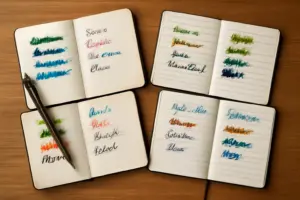
This slot holds my Pilot Custom 742, currently inked with Iroshizuku Tsuki-yo — a muted teal that reads clearly on cream paper. The 742 has a size 15 nib, which is Pilot’s designation for a medium-large gold nib. It costs around $160 new. However, I bought mine secondhand for $95, and it’s been flawless for three years. This pen does 90 percent of my journaling and note-taking.
Slot Two: A Fine-Nib for Precision Work
For signatures, annotations, and anything requiring tight lettering, I carry a Pilot Prera with a fine nib. It’s a demonstrator body — you can see the ink level at a glance. Currently inked with Diamine Oxblood. The Prera retails for around $28 to $35, making it one of the best value fountain pens I’ve ever owned. The snap cap is secure enough that I’m not worried about ink migration during commutes.
Slot Three: A Pencil or Backup Ballpoint
The third slot rotates. Some weeks it holds a Uni Kuru Toga mechanical pencil (0.5mm lead, HB grade) for sketching or margin notes. Other weeks I swap in a Uni-ball Jetstream 0.7mm ballpoint for situations where I need a quick-drying ink — signing receipts, filling out forms on glossy paper. Fountain pen ink doesn’t always play well with coated surfaces. The ballpoint solves that problem immediately.
What I Look For in a Leather Pen Holder
I’ve owned eight pen cases over six years. Fabric pouches stretch and lose their shape. Hard shell cases add unnecessary weight. Magnetic closures are convenient but weak — I had one pop open inside my bag and dump all three pens loose. As a result, I now look for four specific qualities in any case I consider.
- Genuine leather construction — it molds slightly to your pens over time and ages beautifully
- Separate elastic or leather loops — pens should not touch each other inside the case
- A secure closure — snap, zip, or tie, but it must hold under bag pressure
- Slim profile — no thicker than 1 inch when closed, so it sits flat in a jacket pocket or notebook cover pocket
I learned the “separate loops” rule the hard way. My second-ever pen case was a cheap two-slot pouch where both pens shared one open pocket. During a train commute, the pens shifted and the nib on my Lamy 2000 scratched a deep groove into the barrel of my Parker 51. Both pens were fine functionally, but that Parker had sentimental value. The scratch still bothers me when I look at it.
The Case I Actually Use: MIVLXLX Leather Triple Pen Case
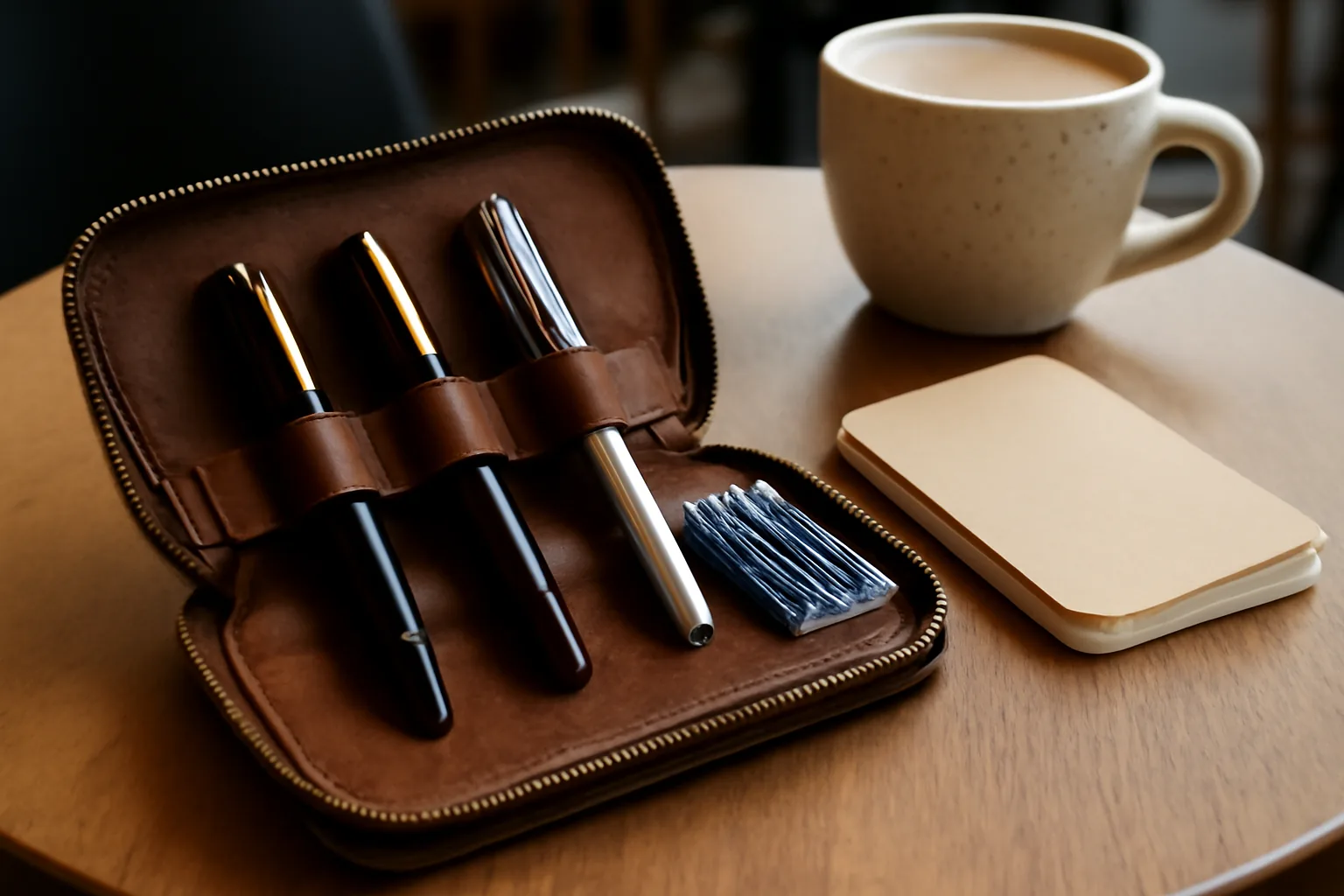
After years of testing, my current daily case is the MIVLXLX Leather Triple Pen Case Pencil Pouch Holder in brown. I’ve been using this specific case for about seven months. It has become the standard against which I mentally measure everything else.
The construction is genuine leather — full-grain feel, not bonded or PU. The brown colorway develops a warm patina with handling. Mine already has a slight darkening along the snap closure from daily use. That kind of natural aging is exactly what I want from a leather accessory. It tells a story.
Each of the three slots is individually separated and sized to hold pens up to roughly 5.5 inches capped. My Custom 742, which runs 5.4 inches capped, fits with a small amount of clearance at the top. The snap closure holds firmly — I’ve shaken the closed case vigorously and nothing shifts. The profile when closed is slim enough to slide into the pen loop on my Leuchtturm1917 notebook cover without distorting it.
What I appreciate most is how it presents at a desk. Open it up, and all three pens are visible and accessible simultaneously. There’s no digging, no unrolling, no fumbling. For anyone who takes notes in meetings or writes in public, that kind of clean accessibility matters. It signals intentionality without being showy about it.
The price point hovers around $15 to $18 on Amazon. For full-grain leather construction at that price, this is genuinely exceptional value. I’d confidently pay $35 for this case. At under $20, it’s the easiest recommendation I make to new pen carriers.
A Runner-Up Worth Considering
If you want something with a more rugged, vintage aesthetic, the Asvine Fountain Pen Case in Crazy Horse Leather is a strong alternative. It features a zippered closure instead of a snap, which some people prefer for added security. The crazy horse leather has a distinctive waxed texture that scratches and buffed back to a shine — classic desk patina behavior. It runs slightly higher, around $20 to $25, and the handmade construction shows in the stitching detail. However, the zip adds a few millimeters of bulk compared to the MIVLXLX. That’s a real trade-off in a jacket pocket carry. For bag carry, it’s a non-issue.
How I Maintain the Case and Pens Together
A pen case is only as good as the maintenance routine around it. I do a quick two-minute check every Sunday morning. I pull each pen, uncap it, and confirm the nib writes smoothly on a scrap page. If a fountain pen skips or railroads, that tells me the ink level is low or the ink has partially dried near the feed. Both issues take under three minutes to fix.
For leather care, I condition the MIVLXLX case every three months with a small amount of Chamberlain’s Leather Milk (Formula 1). I apply it with a microfiber cloth, let it absorb for 10 minutes, then buff it off. The entire process takes five minutes. It keeps the leather supple and prevents cracking along the fold lines near the snap.
One safety note worth mentioning: never store a fountain pen nib-down in a case or cup for extended periods. Gravity pulls ink toward the nib, which can cause flooding or leaking past the section seal. Store pens horizontally or nib-up during long storage. In a case that lies flat, all orientations are essentially neutral — that’s another reason a flat triple case works better than a vertical cup holder for fountain pens specifically.
When a Dedicated Case Isn’t Enough
I want to be honest about limitations here. A triple pen case is a daily carry solution, not a transport solution for fragile or valuable pens. If you’re traveling by air with a vintage pen worth $300 or more, you need a hard-shell case with foam cutouts — something like a Pelican 1010 micro case at around $25, with custom foam. The crush resistance of leather cases is minimal against luggage pressure in overhead bins.
Similarly, if you’re carrying pens with flexible or semi-flex vintage nibs, be conservative about the pens you put in a daily carry case. Flex nibs are more fragile. A direct impact to the nib end — even inside a leather case — can permanently spring the tines. For those pens, I keep them in individual hard pen caps or a separate travel tube, and I don’t EDC them unless the day specifically calls for it.
Also, if your workplace has specific regulations about liquids — some lab environments, for example, restrict liquid inks on the floor — stick to cartridge-converter pens with the converter fully seated, or switch to pencils and rollerballs for that environment. This isn’t a common situation, but it’s worth knowing if it applies to you.
Final Thoughts on Building the Right Everyday Carry Pen Case Setup
The right everyday carry pen case setup isn’t complicated. It’s three decisions made deliberately: which pens matter most to your daily writing, which case protects them without adding friction, and how you maintain both on a simple routine. Get those three things right, and the case becomes invisible infrastructure — quietly enabling better writing every day.
My current setup — Custom 742, Prera, rotating third slot, all in the MIVLXLX leather triple case — has been stable for seven months. That’s the longest I’ve gone without wanting to change something. For a gear tinkerer like me, that’s the loudest endorsement I can give.
Start simple. Pick two pens you genuinely reach for daily. Add a backup. Find a slim leather case that keeps them separated and secure. Use it every day for a month. My guess is you’ll stop treating your pens as an afterthought — and your writing will reflect that almost immediately.
This post contains affiliate links. As an Amazon Associate, I earn from qualifying purchases at no extra cost to you.