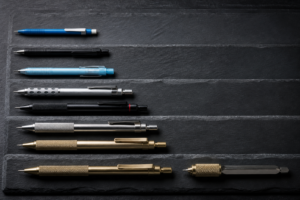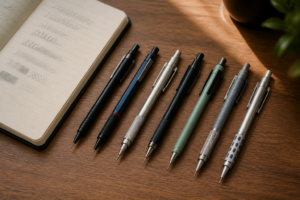
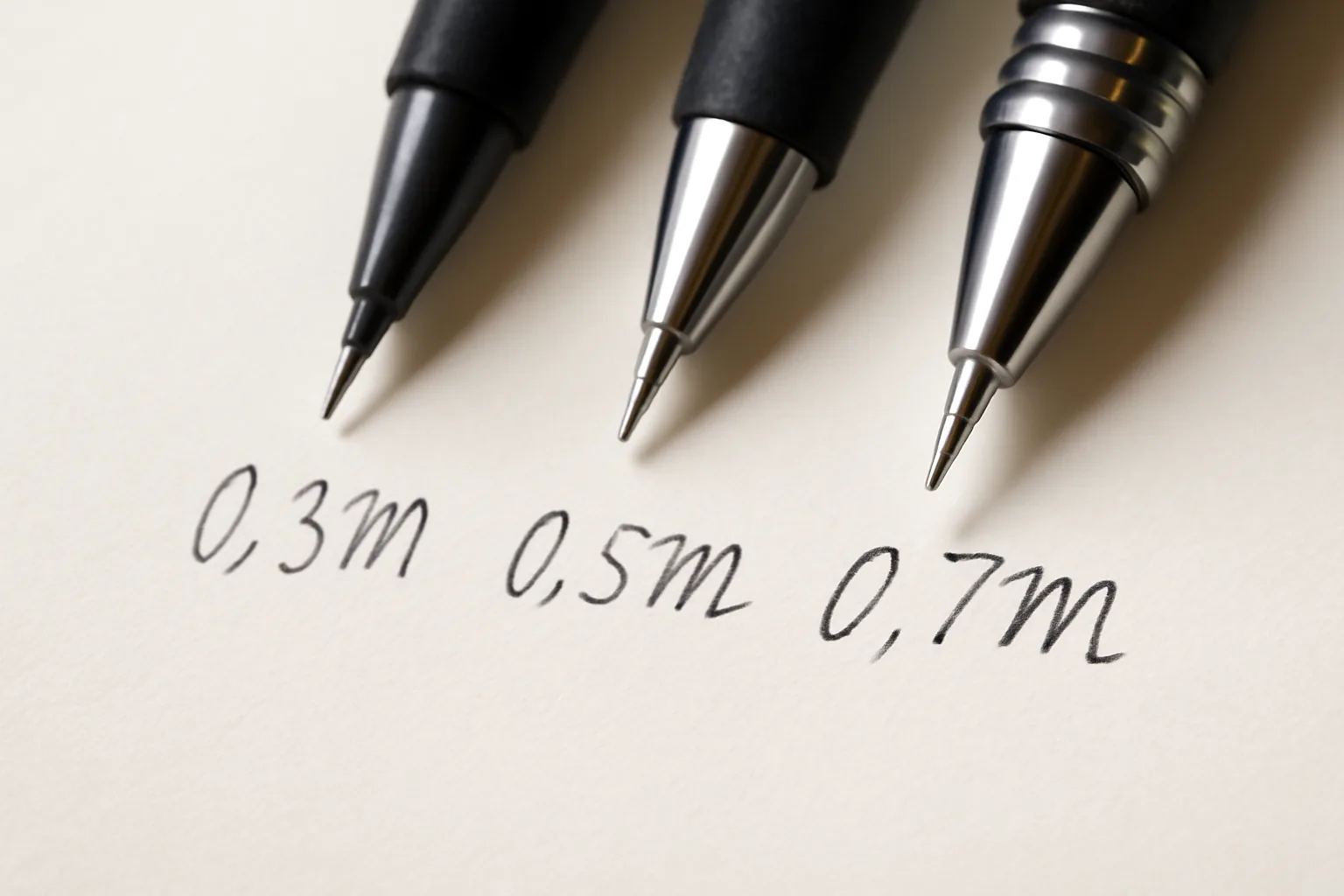
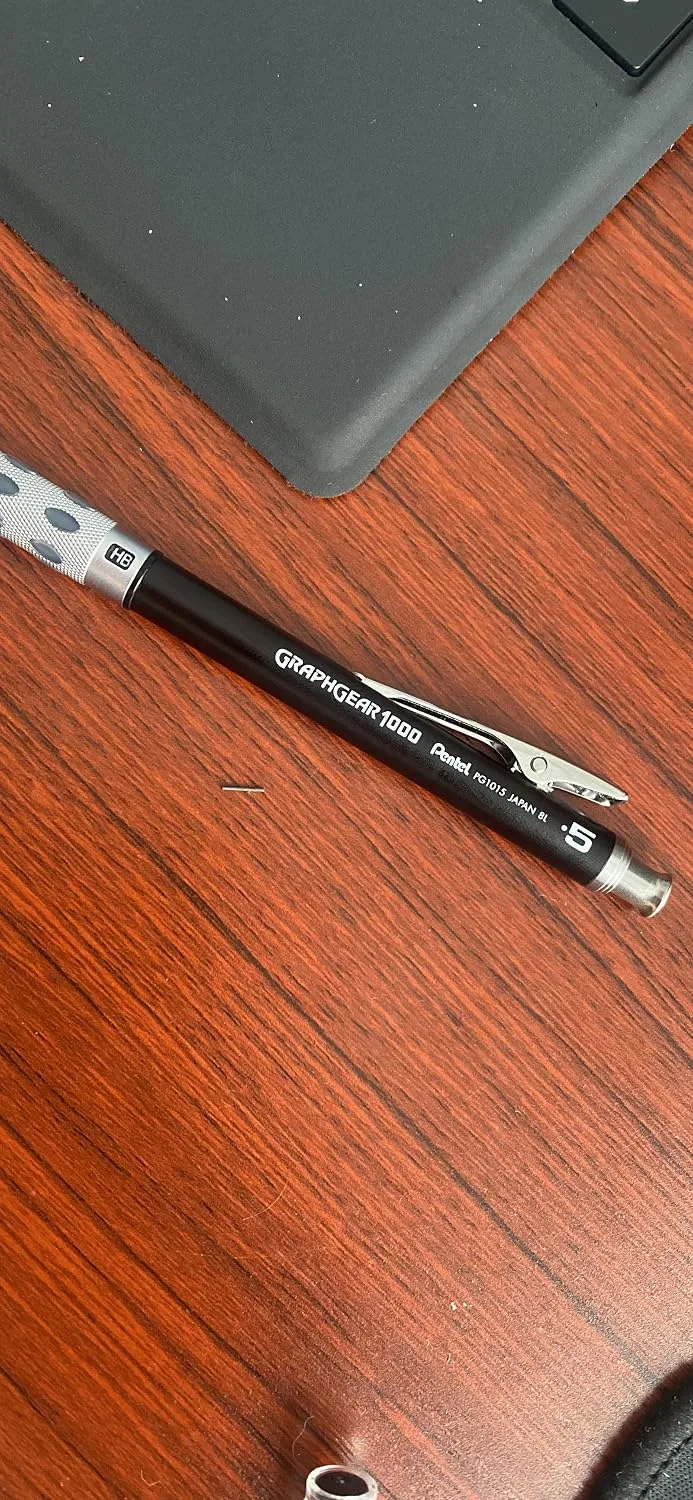
I still remember the afternoon I sat down with three identical Pentel GraphGear 1000 pencils loaded with 0.3, 0.5, and 0.7mm lead and filled an entire journal page with the same sentence. I wanted to feel the difference — not just read about it. What I discovered reshaped how I think about every pencil I pick up. If you’ve ever stared at a lead refill display wondering whether 0.3 vs 0.5 vs 0.7mm mechanical pencil lead actually matters for your handwriting, I’m here to tell you: it absolutely does. The wrong diameter doesn’t just feel off — it fights your hand every single time you write.
Most writers default to whatever lead came loaded in their pencil. That’s understandable. But lead diameter is one of the most personal, high-impact decisions in analog writing. It affects line quality, breakage rate, smear behavior, and how much your hand tires over a long session. After a decade of daily journaling and testing well over 40 mechanical pencils, I’ve developed very strong opinions on this. I’ll share them all here — including the mistake that cost me a ruined journal spread and a hard lesson about pairing lead to paper.
This guide is built for journalers, note-takers, sketchers, and anyone who writes by hand every day. Whether you’re brand new to mechanical pencils or you’ve been using them for years, I’ll help you match lead diameter to your actual hand — not just a generic recommendation from the back of a package.
Why Lead Diameter Is More Than a Spec on the Package
Lead diameter determines the physical width of every stroke you make. That sounds obvious. What’s less obvious is how dramatically it changes the feel of writing — the feedback through your fingers, the resistance on the page, and your margin for error with pressure and angle. These factors compound over a 30-minute journaling session in ways that matter enormously.
Thinner leads like 0.3mm have a higher stiffness-to-diameter ratio. As a result, they require a lighter, more controlled touch. Thicker leads like 0.7mm are more forgiving with pressure but produce bolder lines that can feel chunky for small, precise handwriting. The 0.5mm sits in the middle — but “middle” doesn’t mean “always right.” It means it balances competing demands in a specific way.
There’s also the question of graphite grade, which works in tandem with diameter. ISO pencil grade standards define HB as the midpoint of the hardness scale — balanced between darkness and hardness. For most general writing purposes, HB is the correct starting grade. However, the diameter changes how that HB grade expresses itself on paper. Wider leads lay down more graphite per stroke, so a 0.7mm HB reads darker than a 0.3mm HB at equivalent pressure. That’s physics, not preference.
0.3mm Lead: Precision That Punishes Hesitation
I have a genuine love for 0.3mm lead. I also have a complicated history with it. The first time I loaded a Staedtler 925-35 with 0.3mm HB and tried to write at my normal journaling pace, I snapped three pieces in the first paragraph. The lead is roughly the diameter of a thick human hair — unforgiving if you press even slightly too hard or write at a shallow angle.
That said, when you learn to work with 0.3mm, the results are stunning. Lines are extraordinarily fine, which makes it ideal for small handwriting, detailed annotations, ruled notebooks with tight line spacing (4–5mm Hobonichi-style grids, for example), and technical writing where precision matters. Architects and drafters often standardize on 0.3mm for this reason. The ISO 9177 drafting standards acknowledge sub-0.5mm leads specifically for technical line work.
My honest recommendation: 0.3mm is for writers who already have a light, controlled hand or who are willing to retrain their grip pressure. It’s not a beginner’s lead. Expect to pay $4–7 for a quality tube of 0.3mm refills. Breakage rates are higher, so factor that into your cost per page. For everyday journaling at a relaxed pace, I don’t reach for 0.3mm unless I’m working in a pocket-sized notebook with narrow ruling.
0.7mm Lead: The Workhorse for Relaxed Writers
At the opposite end of the common range sits 0.7mm — the lead diameter that most resembles a standard No. 2 wooden pencil’s output. It writes boldly, breaks rarely, and tolerates a heavy hand with patience. For writers who press firmly into the page, 0.7mm is genuinely the correct choice. Fighting that habit with thin lead only creates frustration.
I recommend 0.7mm specifically for left-handed writers dealing with smear issues, because the bolder line dries more visually distinct even when partially smudged. It’s also excellent for anyone writing on rougher paper stock — standard copy paper, bullet journal dotted pages, or composition notebooks. Rough tooth catches and breaks 0.3mm constantly. For 0.7mm, it’s barely a consideration.
The tradeoff is line width. For large, looping handwriting, 0.7mm is perfect. For small, condensed script in a grid journal, the lines can feel crowded and muddy. In my experience, writers with larger natural handwriting who switch from wooden pencils to mechanical pencils almost always find 0.7mm the most natural transition. Start there if you’re new to mechanical pencils entirely. Refills typically cost $3–6 per tube and last significantly longer than 0.3mm because you break far fewer pieces.
0.3 vs 0.5 vs 0.7mm Mechanical Pencil Lead: Why 0.5mm Wins for Most Writers
After all my testing, 0.5mm is where I land for daily writing — and not because it’s a timid compromise. It’s because 0.5mm was specifically developed as the functional sweet spot for general handwriting. The diameter produces a line width roughly equivalent to a medium ballpoint pen. Most ruled notebooks (college rule at 8.7mm, wide rule at 11mm) were designed with this approximate line width in mind.
Structurally, 0.5mm lead has a good strength-to-diameter ratio. It breaks with hard abuse but handles normal writing pressure without constant snapping. It works on smooth paper and textured paper with equal reliability. For graphite-grade pairing, HB at 0.5mm is the closest thing to a universal standard in mechanical pencil lead. Most lead manufacturers — Pentel, Staedtler, Pilot, Uni — treat 0.5mm HB as their flagship specification. That tells you something.
Specifically, I’ve found 0.5mm HB to be the right call for: daily journaling in A5 notebooks, note-taking during meetings, sketching rough layouts, and any writing context where I’m switching between tasks quickly and can’t afford to babysit my pressure. It also works beautifully in fountain-pen-friendly paper like Tomoe River and Rhodia, where the smooth surface lets thin leads glide without breakage risk. For most people reading this, 0.5mm HB is the answer — and the rest of this guide helps you confirm or refine that.
The Lead That Finally Made 0.5mm Feel Like Home
After testing three different sizes, I realized the difference wasn’t just in the millimeters—it was in the lead quality itself. Grabbing whatever refills were on sale meant my 0.5mm pencil felt scratchy one month and buttery the next, making it impossible to actually compare what the size itself could do.
What works
- Consistent darkness and smoothness across every page, so you’re actually feeling the impact of 0.5mm itself, not fighting grainy or inconsistent lead
- The bulk pack (90 pieces) means you won’t run out mid-experiment, letting you really live with 0.5mm long enough to know if it’s your size
- Minimal breakage during writing, which matters when you’re doing the fine-detail work where lead diameter actually makes a difference
What doesn’t
- The pack size commits you to one size for a while—if you realize 0.5mm isn’t your answer, you’re sitting on 90 refills
- At this quality level, the price per refill climbs, so it’s an investment before you’ve even decided if 0.5mm is worth it
I nearly talked myself out of buying the bulk pack, worried I’d waste money if 0.5mm didn’t stick—but that hesitation was actually the sign I needed to commit to finding out. Get the Pentel Super Hi-Polymer Lead Refills in 0.5mm HB, Pack of 3 (90 pieces total, model C25BPHB3-K6) and give yourself permission to really know your pencil.
This post contains affiliate links. As an Amazon Associate, I earn from qualifying purchases at no extra cost to you.
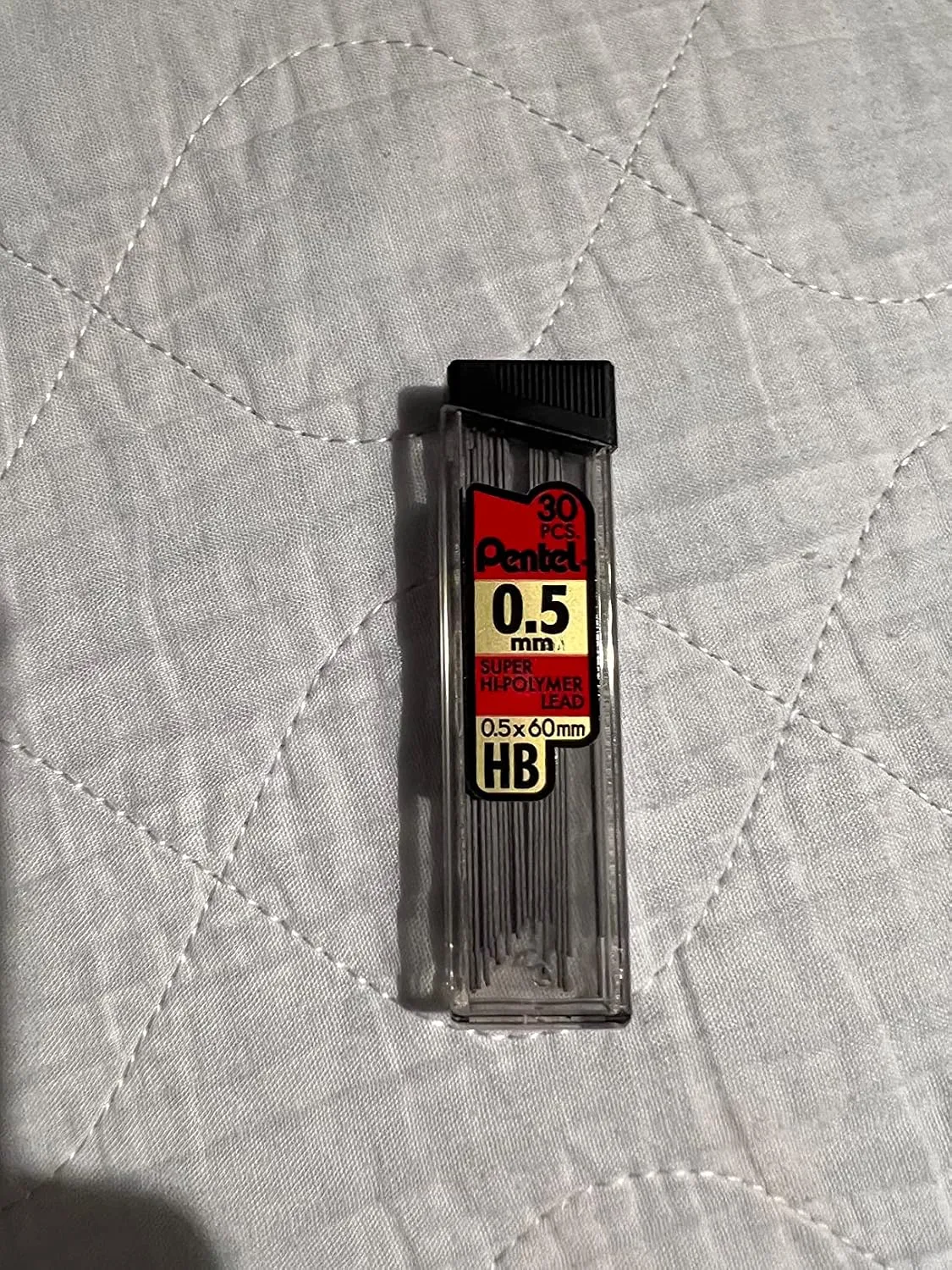
Pentel Super Hi-Polymer Lead Refills in 0.5mm HB, Pack of 3
I tested 0.5mm for weeks with these and didn’t fight breakage or inconsistency once.
Check Price on Amazon →