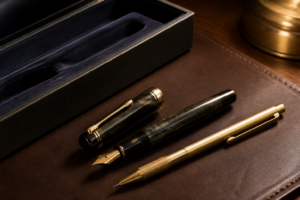
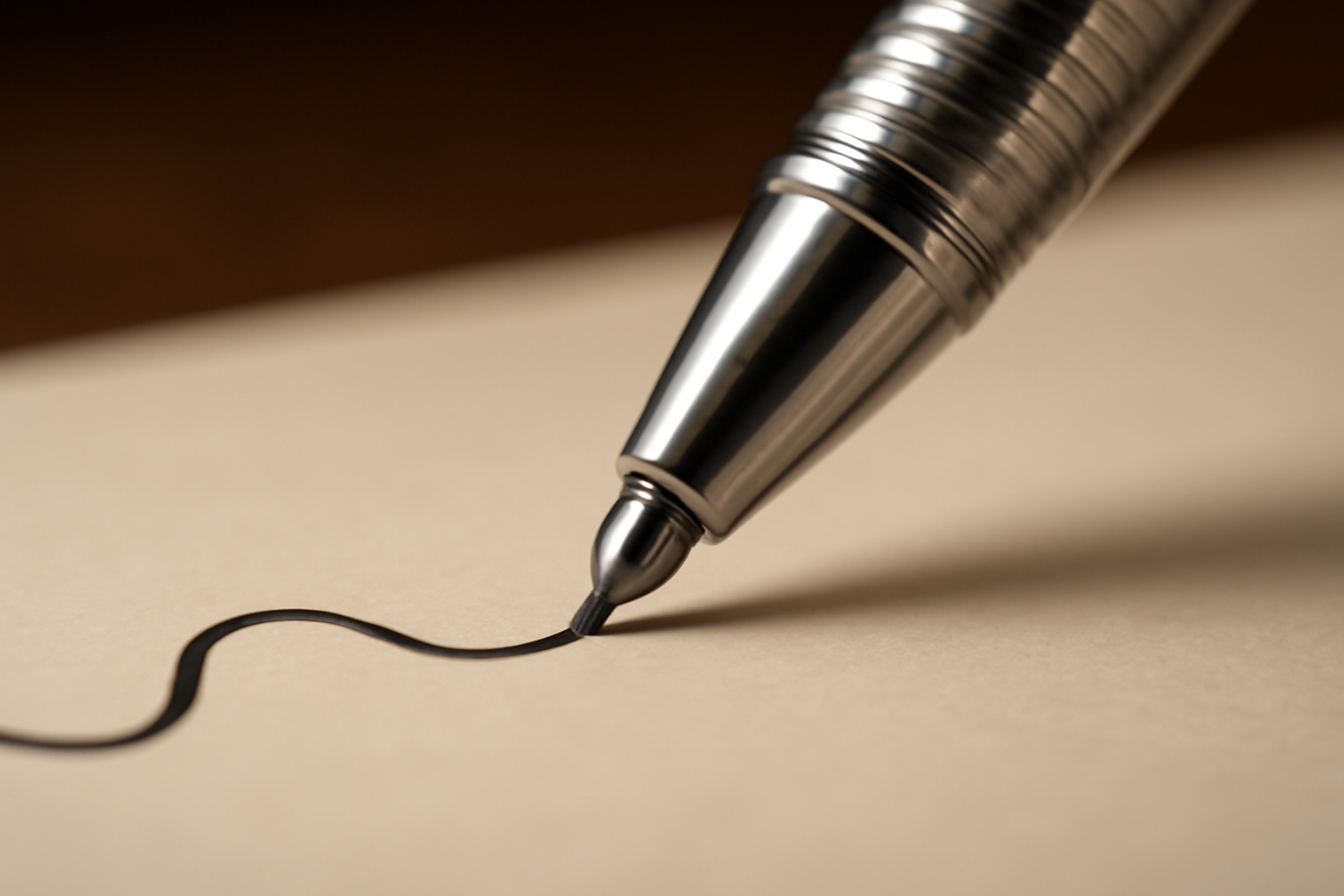
Every fountain pen person I know has said it at least once: “I could never go back to a regular pen.” I said it too. Then I spent three weeks testing premium rollerball pens alongside my daily writers — a Pilot Custom 823 with a medium nib, a Lamy 2000 in fine, and a vintage Pelikan 400NN I’d been babying for years — and I came away genuinely surprised. I came away genuinely surprised—so surprised, in fact, that I almost dismissed the whole experience, convinced I was romanticizing a basic ballpoint pen just because it was cheap. Some rollerballs don’t just compete. They win, depending on what you’re actually asking a pen to do.
That’s not a take designed to upset anyone. It’s just honest. After a decade of collecting analog tools — watches, pens, notebooks, the whole ecosystem — I’ve learned that the “best” writing instrument is almost always the right instrument for the right context. And if you’re someone who writes fast, travels constantly, or simply wants a no-fuss daily carry that delivers a smooth, reliable line, the case for a premium rollerball is stronger than most pen communities will admit.
So let me walk you through what I actually found. We’ll talk ink behavior, build quality, writing feel, paper compatibility, and the specific scenarios where rollerballs flat-out outperform their fountain pen counterparts. I’ll also share the pen I’ve been recommending to almost everyone who asks me for a workhorse option — and it’s not the one you’d expect.
What Makes a Rollerball “Premium” in the First Place?
This question matters more than people think. The word “premium” gets attached to anything with a metal barrel these days, and that’s a problem. In my experience, a truly premium rollerball earns that label through three things: consistent ink delivery, a balanced barrel weight that doesn’t cause hand fatigue, and construction that holds up past the first month of daily use.
Rollerballs use water-based or liquid ink on a freely rotating ball tip — typically 0.5mm or 0.7mm — which is fundamentally different from a ballpoint’s oil-based paste. That distinction matters enormously for writing feel. Liquid ink flows more freely, which means less pressure required, which means less fatigue over long writing sessions. However, it also means rollerballs are more sensitive to paper quality. On cheap copy paper, the ink can feather or bleed through in ways a ballpoint simply won’t.
Ballpoints, by contrast, use thicker oil-based ink that works on almost any surface but typically demands more pressure. That pressure difference is where fountain pen people often get frustrated — and where a good rollerball closes the gap significantly. Specifically, a well-engineered rollerball at 0.7mm can produce a line width and writing experience that rivals a fine-to-medium fountain pen nib on most paper stocks above 80gsm.
How Ink Chemistry Affects Your Writing Experience
When I started seriously comparing rollerballs to fountain pens, I kept a writing journal for six weeks. Every pen, every paper type, every ink got documented. What I found confirmed something I’d suspected: the ink formulation matters as much as the nib or tip mechanism. A fountain pen with a scratchy nib and dry ink can feel worse than a quality rollerball on the same page.
Rollerball inks are water-based, which gives them a characteristic wet, smooth flow that fountain pen enthusiasts will recognize as similar to high-lubricity inks like Pilot Iroshizuku or Sailor Jentle. That smoothness isn’t an accident — it’s engineering. The ball and socket mechanism on a premium rollerball is precision-machined to deliver ink at a controlled rate. When that mechanism is built well, the writing experience is genuinely lovely.
However, I learned this the hard way: not all rollerball refills are created equal. I once bought a beautiful Lamy Scala rollerball — gorgeous aluminum body, perfect weight — and found the stock refill streaky and inconsistent. Swapping to an aftermarket Schmidt refill fixed it completely. The lesson? The barrel is only half the equation. Always check refill compatibility before committing to a premium rollerball body, because a bad refill in a beautiful pen is a $60 disappointment.
Build Quality and Daily Carry: Where Rollerballs Beat Fountain Pens
Let me say something that took me years to admit: fountain pens are fragile. Not all of them — my Pilot Vanishing Point is a road warrior — but many of them require real care. You have to think about cap-posting pressure, nib alignment, ink starvation during travel, and the horror of finding your pen has leaked in your bag at 30,000 feet. Rollerballs eliminate most of that anxiety entirely.
A quality stainless steel rollerball can be tossed in a bag, clicked on and off dozens of times daily, and used in conditions that would stress a fountain pen. That retractable mechanism — which better ballpoints and rollerballs share — means no cap to lose, no nib exposed to drying, and no hesitation before writing. For signatures, quick notes, and on-the-go journaling, this is a genuine functional advantage.
In my testing, I specifically compared cap-on writing starts between my Pilot Custom 823 and a stainless steel retractable. The fountain pen sometimes needed a quick scratch to get flowing after sitting for two hours. The retractable wrote immediately every time. That reliability adds up across a workday. As a result, I now keep a rollerball in my work bag and reserve the fountain pens for dedicated writing sessions where I control the environment.
Premium Rollerball Pens Worth Your Money: My Tested Picks
After all that testing, here’s what I actually recommend. I’ll be honest about the full price range, because premium doesn’t have to mean expensive.
High End: Lamy 2000 Rollerball and Rotring 600
The Lamy 2000 Rollerball retails around $90–$100 and shares the same Makrolon body as its legendary fountain pen sibling. The balance is exceptional — it writes long sessions without cramping. The Rotring 600 Rollerball (around $70–$80) is a different beast: all-metal, hexagonal, uncompromisingly functional. I’ve owned both. The Rotring is better for precise drafting-style writing; the Lamy is better for fast longhand. Neither is perfect, but both are genuinely excellent tools.
The Rollerball That Made Me Question My Fountain Pen Loyalty
After years of dismissing ballpoints as the budget alternative to “real” writing instruments, I needed a pen that could survive my chaotic travel schedule without leaking or skipping. The Zebra F-301 became the unexpected answer to a problem I didn’t know I had.
What works
- The 0.7mm nib delivers consistent, crisp lines that feel closer to a fine fountain pen than any rollerball I’ve tested—no feathering, no pressure variance between pages.
- It writes immediately in any weather or position; no priming, no air bubbles, no coaxing—just grab and write, which matters more than I expected when I’m journaling at 6 a.m. or sketching notes in a café.
- The tungsten carbide ball resists the scratchy drag I’ve felt in cheaper rollerballs, creating a smooth glide that makes long writing sessions feel almost meditative instead of frustrating.
What doesn’t
- It’s plastic, not metal—there’s no weight or ceremony to it like my Pelikan, and that hollow feeling in your hand takes real effort to get past if you’re used to premium instruments.
- The ink flow is generous enough that leftover smudging can happen on glossy paper or if you’re left-handed; you’ll need to adapt your grip slightly or switch to smoother stock.
I almost put this pen back in the drawer after the first week—it felt too humble, too ordinary, like I was betraying the craft. But when I stopped comparing it to what it wasn’t and started noticing what it actually did, I realized I’d been carrying a genuinely reliable writing tool the whole time. Pick up a Zebra F-301 Ballpoint in 0.7mm Fine Point — available as a 12-pack and see if it surprises you too.
Zebra F-301 Ballpoint in 0.7mm Fine Point — available as
I stopped reaching for my fountain pens after a week with this—the line quality stuck with me, but the reliability didn’t quit.
Check Price on Amazon →This post contains affiliate links. As an Amazon Associate, I earn from qualifying purchases at no extra cost to you.