Is that watch on the flea market table a legitimate bargain or a felony waiting to be worn on your wrist? Nine times out of ten, when someone shows me a photo and asks that exact question, the answer is neither exciting nor complicated — it’s a fake, full stop. A buddy of mine once sent me a picture of a Rolex Submariner he’d spotted at a swap meet: green dial, cyclops lens, not a scratch on it, tagged at $180. I could tell what it was before he finished typing the message. What took real time was untangling, for someone who’d never had reason to care, the actual difference between homage watches vs counterfeits — a distinction that gets mangled constantly, and one that ends up costing people real money, their credibility, and occasionally their standing with the law.
Ten-plus years into this habit — everything from a $15 Seiko to a vintage Omega Constellation running a cal. 561 — I’ve had both honest homages and outright counterfeits pass through my hands more times than I bothered counting. The gap between the two categories isn’t academic; it’s substantial and worth taking seriously. One side is a genuine, respectable corner of the market with real craftsmanship behind it. The other side is simply fraud wearing a nicer face. Here’s exactly where I draw that line, and why the line matters more than people assume.
So What Actually Counts as an Homage Watch?
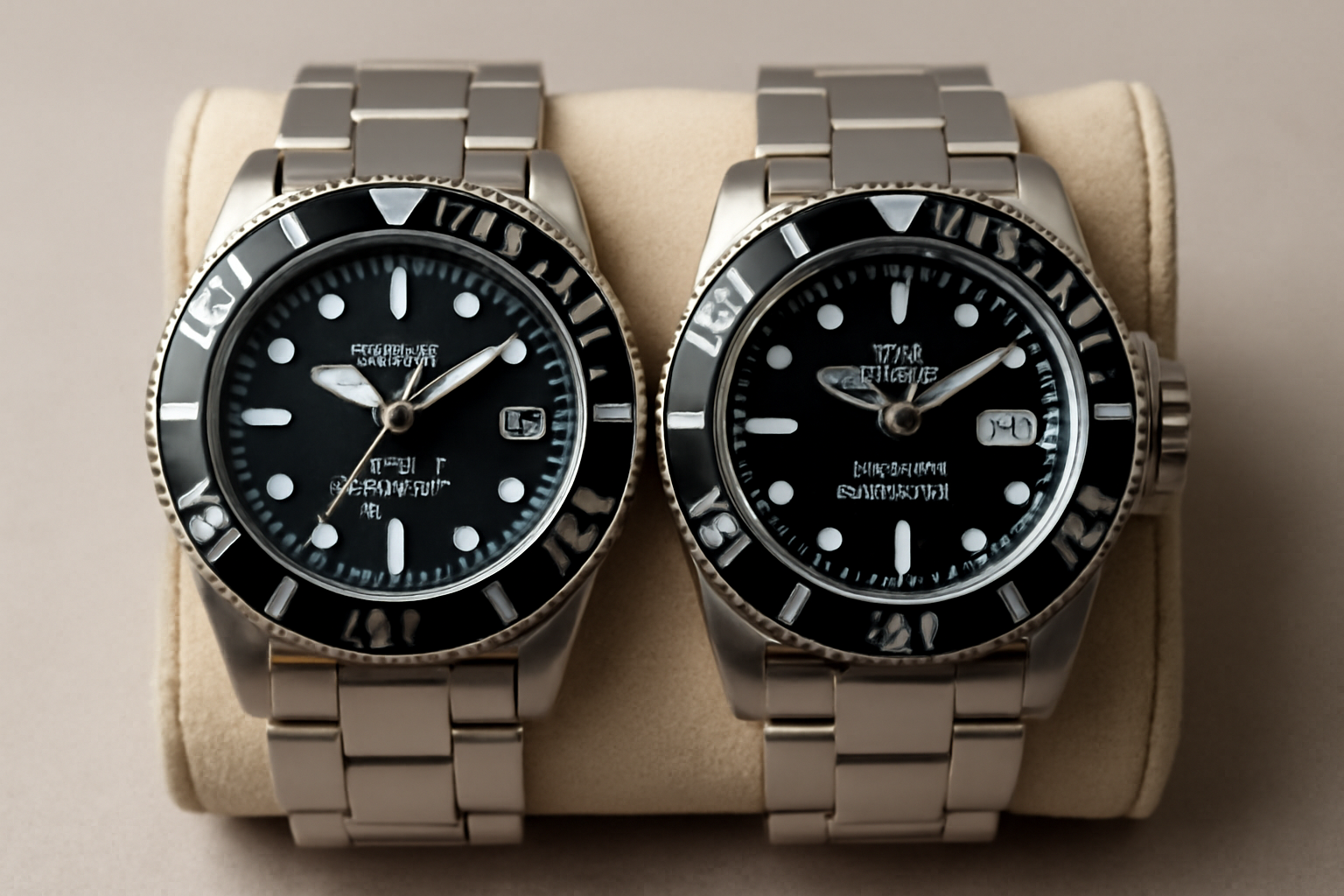
An homage borrows a silhouette from a famous reference piece but stops well short of stealing the brand name, logo, or anything trademarked. Picture it as a nod to a classic design rather than a forgery of one. Nobody looking at Orient’s Ray II diver mistook it for a Rolex — but the bloodline of classic dive-watch design was unmistakably there in the case shape and bezel. That resemblance is on purpose, and it’s entirely within the law.
Homages sit in a completely different legal and ethical bracket than counterfeits do. Companies like Seiko, Orient, Citizen, Casio, and Steinhart have built full catalogs around shapes that rhyme with luxury icons. Take my Seiko SKX007, which I’ve beaten up for three years including regular saltwater dives — its lineage clearly runs back to the Submariner’s profile. But it never hides what it is: Seiko name on the dial, Seiko NH36 caliber inside, Seiko’s own case finishing throughout. Nobody walks away confused about what they own.
My take, after years of watching this play out, is that the homage category exists for a good reason: solid design shouldn’t be locked behind a velvet rope. A Submariner runs $9,000 to $10,000 retail, assuming you can even find one at that number, which is its own separate headache. An homage in the $50–$400 range hands someone that same functional design language, minus any pretending. I have zero problem with that trade.
Homage Watches vs Counterfeits: Where the Real Split Happens
Here’s the fork in the road, laid out plainly. A counterfeit does precisely what an homage refuses to do — it duplicates registered logos, brand names, and protected design elements, and it does so specifically to trick a buyer into believing they’re holding the genuine article. That intent to mislead is what separates the two, legally and morally, full stop.
These are the markers I rely on after years of sorting one from the other:
- Branding: An homage carries its own name and mark. A counterfeit lifts the original maker’s name outright, often reproducing the exact fonts and crown logo down to the pixel.
- Intent: The person buying an homage knows precisely what’s landing on their wrist. A counterfeit is pushed under a lie — sometimes fooling buyers who genuinely believe they’ve scored the real deal.
- Legal footing: Homages are legal almost everywhere you’d travel. Counterfeits break trademark and IP law in essentially every country that has such laws on the books.
- Reselling ethics: Listing an homage as exactly that is perfectly fine. Passing off a counterfeit as authentic — even by accident — puts you in genuine legal jeopardy.
- Openness about quality: Homage makers publish their specs without flinching. Counterfeit sellers stay vague about the movement inside because the truth wouldn’t survive daylight.
That final point deserves emphasis. I’ve personally popped open counterfeit casebacks and found movements that didn’t even match the caliber printed on the dial — nameless Chinese clones with zero service network, zero spare parts, and zero accountability behind them.
The Mistake That Taught Me This Lesson
Full disclosure: I stumbled here myself, back when I was still new to this. In Barcelona, at a street stall, I bought what I was told was “gray market” old stock — a vintage Omega Seamaster, around €90. The dial read Omega, plain as day. What sat underneath, though, was a Chinese ETA clone, complete with “Swiss Made” stamped on a bridge that had never once been within a thousand miles of Switzerland.
The damage went well beyond the €90. I handed a watchmaker $65 just to crack it open, confirm the fake, and tell me plainly to cut my losses. Worse than the cash, though: I’d nearly strapped that thing on for a watch meetup, which would’ve been a genuinely mortifying moment in front of people whose opinion I actually valued. The takeaway landed immediately and never left: when the price looks too good, it’s because it is.
What I didn’t grasp yet — but see clearly now — is that owning an honest homage carries no shame at all. The shame only shows up when you pretend it’s something it isn’t. That single distinction is basically the backbone of any integrity this hobby has.
Catching a Fake Before Money Changes Hands
Flea market table, gray-market dealer, or an online listing — doesn’t matter which. These are the checks I run without fail, every time. A decade in, none of this requires conscious thought anymore.
Open Up the Caseback
Always ask to see inside. A real Rolex shows a rotor engraved to the brand’s exact finishing standard. A real Seiko SKX shows a properly stamped NH35 or 7S26. Fakes tend to show off generic movements dressed up with counterfeit engravings, or sometimes an entirely wrong caliber altogether. Any seller who won’t open the caseback should lose your business on the spot — a legitimate one always will.
Study the Dial Text Closely
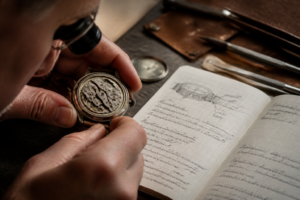
Put it under a loupe — mine’s 10x — and counterfeit dials tend to give themselves away through bleeding ink, uneven depth in the printing, and indices that don’t quite line up. Legitimate dials, even on inexpensive pieces, print crisp and consistent. That said, you need something to compare against, so I always check the piece against verified official photos from the brand before drawing any conclusions.
Judge the Heft and the Crown
Cheaper metals show up in counterfeits, and you can feel it. An authentic Submariner on its bracelet weighs roughly 155 grams; most fakes land noticeably lighter than that. On top of that, a real screw-down crown on a genuine diver threads in smoothly and with confidence. Fake crowns tend to feel grainy, cross-thread without warning, or strip out after just a handful of uses.
The Homage That Made the Distinction Click for Me
If you’re trying to grasp what an homage actually is without owning the reference piece to hold up against it, you need proof of concept — something built with genuine respect for a classic but no illusions about being that classic. The Casio MDV-106B lands squarely in that honest middle territory.
Where it delivers
- It’s a Submariner homage that doesn’t hide its influences — anyone who knows the genre will spot the reference instantly, but nothing on the dial or case is trying to trick anybody.
- The fit and finish feel deliberate rather than cynical — nothing about it reads as a knockoff angling to fool someone, and it’s honestly satisfying to wear day to day.
- At $80 to $100, it’s cheap enough that you can wear the thing while explaining the homage-versus-counterfeit divide to a friend and not wince about the money involved.
Where it falls short
- The case and dial proportions track close enough to the Submariner that certain people will still just see “fake” instead of grasping the homage angle at all.
- Being quartz rather than mechanical, it will never carry that prestige-object weight that makes people understand, viscerally, why luxury watches get counterfeited in the first place.
I almost bought the counterfeit version my friend found—it would’ve been faster, cheaper, and honestly looked more “correct” at first glance. But wearing the Casio MDV-106B Duro taught me that the point of a homage is the honesty, not the deception.
About This Article

Written by Ellen Ashford. Watch collector, fountain pen enthusiast, and lifelong journaler. Time & Ink is where I explore the craft of analog living — from vintage timepieces and fine stationery to the simple pleasure of putting pen to paper. More about this site.
Verify this against a primary source
Specifics change, and your situation may differ from the one described here. These are the authorities worth checking directly:
- NAWCC — horological reference, archives and research library
- Smithsonian Institution — collection records for historic timepieces and writing instruments