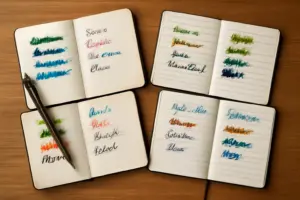
A few years ago, I paid $340 for a vintage Parker 51 at an estate sale. The seller called it a “bargain.” My husband called it something less flattering. But the moment I inked that pen and felt the hooded nib glide across Rhodia paper, I understood something fundamental about the vintage vs modern stationery value debate — it is almost never purely about the object. It is about what the object makes you feel and what it makes you do. That distinction shapes every buying decision I make today.
I have been collecting fountain pens and vintage paper goods for over twelve years. My current rotation includes everything from a 1952 Esterbrook J to a 2023 TWSBI Eco. I have journaled every single day for eight years straight. That is more than 2,900 consecutive journal entries across vintage composition books, modern dot-grid notebooks, and everything in between. So when people ask me where the real value lies in the vintage versus modern stationery conversation, I do not guess. I answer from experience.
Here is what I have learned: the answer is nuanced, but it is not mysterious. Vintage stationery holds specific kinds of value exceptionally well. Modern stationery wins in other categories cleanly and decisively. Understanding those categories will save you money, sharpen your collection, and make your daily writing practice significantly more satisfying.
What “Value” Actually Means in the Vintage vs Modern Stationery World
Most people collapse “value” into a single question: is it worth the money? In my experience, stationery value actually has four distinct dimensions. There is monetary value — what you could resell it for. There is functional value — how well it performs its intended job. There is emotional value — the joy, ritual, and meaning attached to using it. Finally, there is historical value — the cultural and craft significance of the object itself. Vintage and modern stationery each dominate different categories on that list.
Vintage items, for example, almost always win on historical and emotional value. A Sheaffer Snorkel from 1952 carries a story. It survived seventy years. Someone wrote letters with it — love letters, maybe, or business correspondence that shaped a company. That narrative adds weight to the object in your hand. Modern stationery, however, wins decisively on functional value and consistency. A brand-new Pilot Custom 823 will perform flawlessly out of the box, every single time. That reliability matters enormously if you are a daily writer rather than a collector.
Monetary value is where things get genuinely complicated. A minty Parker Vacumatic can fetch $150 to $400 depending on condition and color. However, a modern Nakaya Piccolo starts at around $500 and holds its value remarkably well because of its handcrafted urushi lacquer process. Neither category automatically wins here. Condition, rarity, brand reputation, and current collector demand all interact to determine resale value in ways that require real market knowledge.
Where Vintage Stationery Genuinely Outperforms Modern
Vintage stationery has real, documentable advantages in specific areas. Let me walk you through the ones I have confirmed through hands-on experience over twelve years of collecting.
Nib Quality and Flex Characteristics
Pre-1960s fountain pen nibs were frequently made from 14k or 18k gold with hand-ground tipping. The result was a springiness and line variation — what collectors call “wet noodle” flex — that modern mass production rarely replicates. My 1948 Waterman 52 has a flex nib that opens from a fine line to a 3mm broad stroke with almost no pressure. I have tested dozens of modern flex nibs under $200. None of them come close to that feel. For calligraphers who want vintage-style line variation, authentic vintage nibs are genuinely superior tools.
Paper Weight and Texture in Vintage Journals
Vintage paper goods — particularly mid-century American composition books and British ledger paper — were often made with higher rag content than their modern equivalents. Rag paper (cotton fiber rather than wood pulp) resists feathering, ages with far less yellowing, and has a tactile quality that modern paper rarely matches. I have fountain pen journals from the 1940s with paper that still writes beautifully today. That longevity is not nostalgia. It is chemistry.
That said, sourcing usable vintage paper goods is genuinely difficult. Foxing, moisture damage, and brittle pages are common problems. I have purchased vintage blank books at estate sales for $8 that turned out to be completely unusable due to water damage. Always inspect vintage paper goods in person before buying if at all possible.
Where Modern Stationery Wins Clearly and Decisively
I want to be direct here, because I see a lot of vintage romanticism online that does a disservice to modern stationery. Modern products have made remarkable advances. Dismissing them entirely is a collector’s mistake.
Consistency, Reliability, and Warranty Protection
Modern fountain pens come with warranties. A new Lamy Safari costs around $35 and will write consistently from the first fill. Vintage pens require restoration — new sac material (usually silicone or latex), pressure bar adjustment, nib smoothing with 12,000-grit micromesh. A professional restoration typically costs $40 to $80 per pen. Factor that into your “deal” price on any vintage pen.
I learned this the hard way with a 1955 Sheaffer Snorkel I bought for $25 at a flea market. I was thrilled. Then I discovered the sac had completely disintegrated inside the barrel. The restoration cost $55. My $25 bargain became an $80 pen. It writes beautifully now — but I could have bought a brand-new pen with equivalent performance for less.
Ink Compatibility and Modern Ink Chemistry
Modern fountain pen ink has advanced dramatically in the last decade. Iron gall inks, pigmented inks, shimmering inks with gold particles, and pH-neutral archival inks are widely available from brands like Diamine, Noodler’s, and Pilot Iroshizuku. Many vintage pens cannot safely use pigmented or iron gall inks without risk of corrosion or clogging. Modern pens are engineered with these ink types in mind. If ink variety matters to you — and it should if you are a serious journaler — modern pens give you dramatically more flexibility.
The Smart Middle Path: Handcrafted Modern Pens with Vintage Soul
Here is the recommendation I give most often to people new to fountain pens who feel drawn to vintage aesthetics but want modern reliability: look for handcrafted modern pens made from natural materials. They bridge both worlds genuinely well.
Last spring I started testing a set that has genuinely impressed me for the price point. The cobee® Vintage Wooden Fountain Pens Set (3-piece, Model B) uses handcrafted wooden barrels with a 0.5mm fine nib and includes 12 standard 2.6mm ink cartridges. I was skeptical going in. Wooden-barreled pens at this price point have historically disappointed me with rough feeds or nib alignment issues. This set surprised me.
The wood grain on each pen is genuinely different — these are not injection-molded plastic with a printed wood texture. The writing feel at 0.5mm is smooth enough for daily journaling without scratchiness. I used one pen exclusively for six weeks in my morning pages practice. Ink flow remained consistent throughout, and the cartridge swap took about thirty seconds. For someone who wants that warm, tactile, vintage-adjacent writing experience without the $80 restoration gamble, this set is a legitimate starting point.
The three-pen format also makes this an excellent gift set for someone you want to introduce to fountain pen writing. I gave one set to my sister-in-law last December. She has been journaling daily ever since. That outcome matters to me more than any technical specification.
A Solid Runner-Up Option Worth Considering
If you want the same handcrafted wooden aesthetic with the added benefit of a gift box — useful for presenting this as a gift — the cobee Handcrafted Wooden Fountain Pens Set with Gift Box (Model B) is the version to consider. It includes the same 0.5mm fine point nibs and 12 cartridges. The gift box packaging is genuinely presentable — not an afterthought. For calligraphy students, journaling beginners, or anyone setting up a home writing desk, this is a strong option at the same price tier.
How to Evaluate Value Before You Buy: A Practical Framework
After twelve years of purchases, I have developed a simple evaluation framework. I use it every time — whether I am at an estate sale holding a vintage Wahl-Eversharp or browsing a stationery shop’s modern pen wall.
- Define your primary use case first. Daily writing demands reliability above all. Collecting and display can prioritize rarity and historical significance. Calligraphy needs nib flexibility. Knowing your primary purpose prevents expensive mismatches.
- Price the total cost of ownership. A vintage pen at $30 plus $60 restoration equals $90 — before ink. Be honest about that math every single time.
- Research the specific model, not just the brand. Parker made extraordinary pens and mediocre ones. Knowing that a Parker 51 Aerometric from 1950–1967 is a reliable workhorse — while the Parker 61 capillary filler from the same era is a maintenance nightmare — requires model-level research.
- Handle it before you buy when possible. Nib feel, barrel weight, and section grip are personal preferences. No review, including mine, substitutes for holding the pen yourself.
- Check the Goulet Pens or FPN community price guides. The Fountain Pen Network (FPN) maintains community-sourced pricing data. Goulet Pens publishes educational content on fair market values. Both are free resources I reference regularly before making significant purchases.
When to Consult a Professional Pen Restorer
I restore basic vintage pens myself. Sac replacement, pressure bar adjustment, and light nib smoothing are all within reach for a patient amateur. However, there are clear situations where I send pens to a professional restorer without hesitation.
- Cracked or hairline-fractured barrels. Repairing celluloid or hard rubber cracks requires heat tools and adhesives that can permanently destroy the pen if misapplied.
- Sprung or misaligned tines on gold nibs. Realigning tines on a vintage 14k nib without the correct tools will make the problem significantly worse. I know this from painful personal experience involving a $220 pen and a lot of regret.
- Lever box replacements on pre-1940s pens. The mechanisms are fragile. The tolerances are unforgiving. A professional restorer typically charges $25–$45 for this service. It is worth every cent.
- Any pen with significant monetary or sentimental value. If the pen belonged to a relative or is worth more than $150, please do not experiment on it yourself. The risk-reward calculation does not support it.
I recommend finding a restorer through the American Pen Collectors Society (APCS) or through verified recommendations on the Fountain Pen Network forum. Always ask for references and a written estimate before any work begins.
Final Thoughts on Vintage vs Modern Stationery Value
After twelve years and more money than I will admit publicly, my honest position on the vintage vs modern stationery value question is this: the most valuable stationery is the stationery you actually use. Full stop.
Vintage stationery wins on historical depth, emotional resonance, and specific nib characteristics that modern manufacturing has not fully replicated. However, modern stationery wins on reliability, ink compatibility, consistency, and total cost of ownership. Neither camp dominates unconditionally. The smartest collectors and writers I know draw from both freely and without ideology.
If you are just starting out, begin with a dependable modern pen that fits your hand and your budget. Build your practice first. Then, once you know what you love about writing by hand, start exploring vintage pieces with clear eyes and realistic expectations. The vintage vs modern stationery value conversation gets a lot easier once you know what you are actually shopping for.
Your pen is a tool. Use it. Fill it with beautiful ink, press it to good paper, and write something that matters. That is where every single dollar spent on stationery — vintage or modern — ultimately justifies itself.
This post contains affiliate links. As an Amazon Associate, I earn from qualifying purchases at no extra cost to you.