I ruined a full month of journal entries because I trusted the wrong notebook. My then-favorite wet-noodle flex nib was loaded with Diamine Registrar’s ink — a particularly saturated, slow-drying formula — and every single page bled straight through to the back. The fountain pen notebook bleed ghost test I should have run before committing to that journal would have saved me thirty pages of frustration. If you write with fountain pens and you care about the quality of your pages, this ranking is the one I wish had existed three years ago.
Not all notebooks are created equal. Paper weight, sizing agents, cotton content, and surface texture all determine how a sheet handles liquid ink. A 90 gsm paper can outperform a 100 gsm paper if the former uses better sizing. That’s the chemistry behind why some budget notebooks surprise you and some premium ones disappoint. I’ve tested more than thirty notebooks over the past four years, logging results with at least five different inks per book — from dry writers like Pilot Iroshizuku Ku-jaku to notorious bleeders like Noodler’s Baystate Blue.
This post lays out my rankings with real data: ink types used, nib sizes, drying times observed, and honest notes on bleed-through and ghosting. I’ll also tell you which notebook I now reach for every single day — and why one specific format edges out every competitor I’ve tried.
What Bleed and Ghosting Actually Mean (And Why They’re Different Problems)
Bleed and ghosting are often lumped together, but they’re distinct issues with different causes. Bleed-through happens when ink saturates the paper fibers entirely and soaks to the reverse side. You can see the actual ink marks from the back of the page. Ghosting (sometimes called show-through) is subtler — the ink stays on the front side, but the writing is visible as a shadowy impression when you hold the page to light, or even in normal reading conditions with dark inks.
Bleed is a paper sizing problem. Sizing agents — typically alum-rosin, gelatin, or AKD (alkyl ketene dimer) — create a barrier that slows ink absorption. Papers with weak or insufficient sizing allow ink to wick freely through the fiber structure. Ghosting, however, is primarily a paper weight and opacity issue. A 70 gsm sheet with perfect sizing may still ghost because the paper itself is thin enough to allow light transmission.
In practical terms: bleed ruins the page behind your writing. Ghosting makes it hard to use both sides of a sheet. For serious journalers and letter writers, both matter enormously. My testing methodology accounted for both — I scored each notebook on a 1–5 scale for bleed and ghosting separately, using a wet flex nib (my Pilot Falcon with a soft nib), a standard medium nib (LAMY Safari M), and a broad nib (Pelikan M400 B).
My Fountain Pen Notebook Bleed Ghost Test: The Full Ranking
I’ll be direct: most notebooks fail fountain pen writers at some level. Out of thirty-plus notebooks tested, only eight earned what I’d call “daily driver” status. Here are the standouts — good and bad.
Tier 1 — Excellent: Near-Zero Bleed, Minimal Ghosting
- Tomoe River Paper (Hobonichi, Taroko Studio): 52 gsm but engineered specifically for wet ink. Virtually zero bleed with any nib. Ghosting is present but faint. Ink drying time runs 20–40 seconds, which is the tradeoff.
- Clairefontaine / Rhodia (90 gsm): The classic benchmark. Bleed score: 5/5. Ghosting score: 4/5. Smooth, reliable, and widely available for around $12–$18 per notebook.
- LEUCHTTURM1917 (80 gsm): My personal top pick for everyday journaling. More on this below — it earns its place through real-world consistency, not just lab conditions.
Tier 2 — Good: Minor Issues With Wet Nibs or Saturated Inks
- Moleskine (70 gsm): Bleed score: 3/5 with broad nibs. Significant ghosting on both sides. The finish feels smooth, but it’s actually moderately absorbent. Not worth the $20+ price.
- Midori MD (MD-paper, ~72 gsm): Excellent ghosting resistance, but shows bleed with wet flex nibs and iron gall inks. Great for drier writers. Drying time is fast — under 10 seconds for most inks.
- Maruman Mnemosyne (70 gsm): Surprising performer for the price (~$8–$10). Handles medium nibs beautifully. Broad nibs push it into minor ghosting territory.
Tier 3 — Avoid: Consistent Bleed and Heavy Ghosting
- Generic composition notebooks and most “sketch” books: Even with a fine nib and dry ink, bleed is near-universal. These are made for pencil and ballpoint.
- Paperblanks notebooks: Beautiful covers, mediocre paper. 85 gsm but with inconsistent sizing. I tested three different editions and got three different results — that inconsistency alone disqualifies them.
- Field Notes (original): 60 gsm paper designed for pencil and ballpoint. Bleed score: 1/5 with any wet nib. I love them for pencil. They are not fountain pen notebooks.
Why Paper GSM Is Only Half the Story
Here’s something I had to learn the hard way: I spent two months chasing high-gsm notebooks thinking weight alone meant fountain pen friendliness. I was wrong. Paper weight (grams per square meter) measures density, not ink resistance. A 100 gsm uncoated wood-pulp paper can bleed worse than 52 gsm Tomoe River because the sizing — not the weight — controls ink behavior.
Sizing determines how much the paper surface resists liquid penetration. Internal sizing (added during pulp processing) and surface sizing (applied as a coating after sheet formation) both matter. Tomoe River uses a proprietary surface sizing that essentially creates a near-impermeable barrier. Rhodia’s 90 gsm uses heavy internal sizing with a slightly calendered surface. The result is that both papers resist ink at the structural level, not just at the surface.
Ink chemistry also plays a role. Dye-based inks (like most standard bottled inks) absorb faster than pigmented inks. Iron gall inks — which are acidic and thin — penetrate more aggressively than neutral pH inks. Noodler’s Baystate Blue is notoriously difficult to control because its pH and dye concentration push through even moderate sizing. I always test any new notebook with Baystate Blue first. If it passes that test, it’ll handle almost anything.
The Notebook I Reach for Every Day: LEUCHTTURM1917 A5 Hardcover
I’ve been using LEUCHTTURM1917 notebooks almost exclusively for daily journaling since 2021. That’s not brand loyalty — it’s the result of direct comparison testing against Rhodia, Clairefontaine, and Midori MD over an eighteen-month period. The LEUCHTTURM consistently performed within 5–10% of the Rhodia on my bleed and ghosting tests while offering features that matter to me as a journaler: numbered pages, a table of contents, two ribbon bookmarks, and an expandable pocket.
The paper is 80 gsm with a smooth, lightly textured surface that shows off shading beautifully. Specifically, it handles iron gall, pigmented inks, and even Baystate Blue with only minor ghosting visible in strong backlight — no bleed on medium or fine nibs. With a broad or wet flex nib, you’ll see light ghosting but zero bleed-through. Drying times average 8–15 seconds with standard dye-based inks on a medium nib, which is fully acceptable for normal writing speed.
My current everyday journal is the LEUCHTTURM1917 Hardcover Medium A5 in Black with Squared pages. I specifically chose the squared (dot-free grid) format because it gives me layout flexibility for both writing and small sketches or diagrams without the dots interfering visually. The hardcover holds up beautifully — I carry mine in a bag every day, and after six months of use, the spine shows no cracking. At roughly $22–$25, it’s priced fairly for what it delivers.
If black isn’t your color, or if you prefer ruled lines over a grid, the LEUCHTTURM1917 Hardcover Medium A5 in Navy with Ruled pages performs identically on paper quality tests. Same 80 gsm stock, same sizing, same bleed resistance. The navy cover is striking — several friends have asked about it after seeing it on my desk. It’s also frequently a few dollars cheaper, making it a strong value pick if you’re new to the brand and want to test it before committing.
How to Run Your Own Notebook Test at Home
You don’t need a lab to evaluate a notebook before committing to a full journal. Here’s the exact process I use when evaluating any new notebook. It takes about fifteen minutes and gives you reliable data.
- Choose three inks: A dry writer (Pilot Iroshizuku or Waterman), a standard writer (Diamine Oxblood), and a wet problem ink (Noodler’s Baystate Blue or any iron gall).
- Use three nib sizes: Fine, medium, and broad — or whichever you actually use daily. No point testing a broad if you only own fine nibs.
- Write a full paragraph with each combination. Don’t just make a single swipe. Simulate real writing pressure and speed.
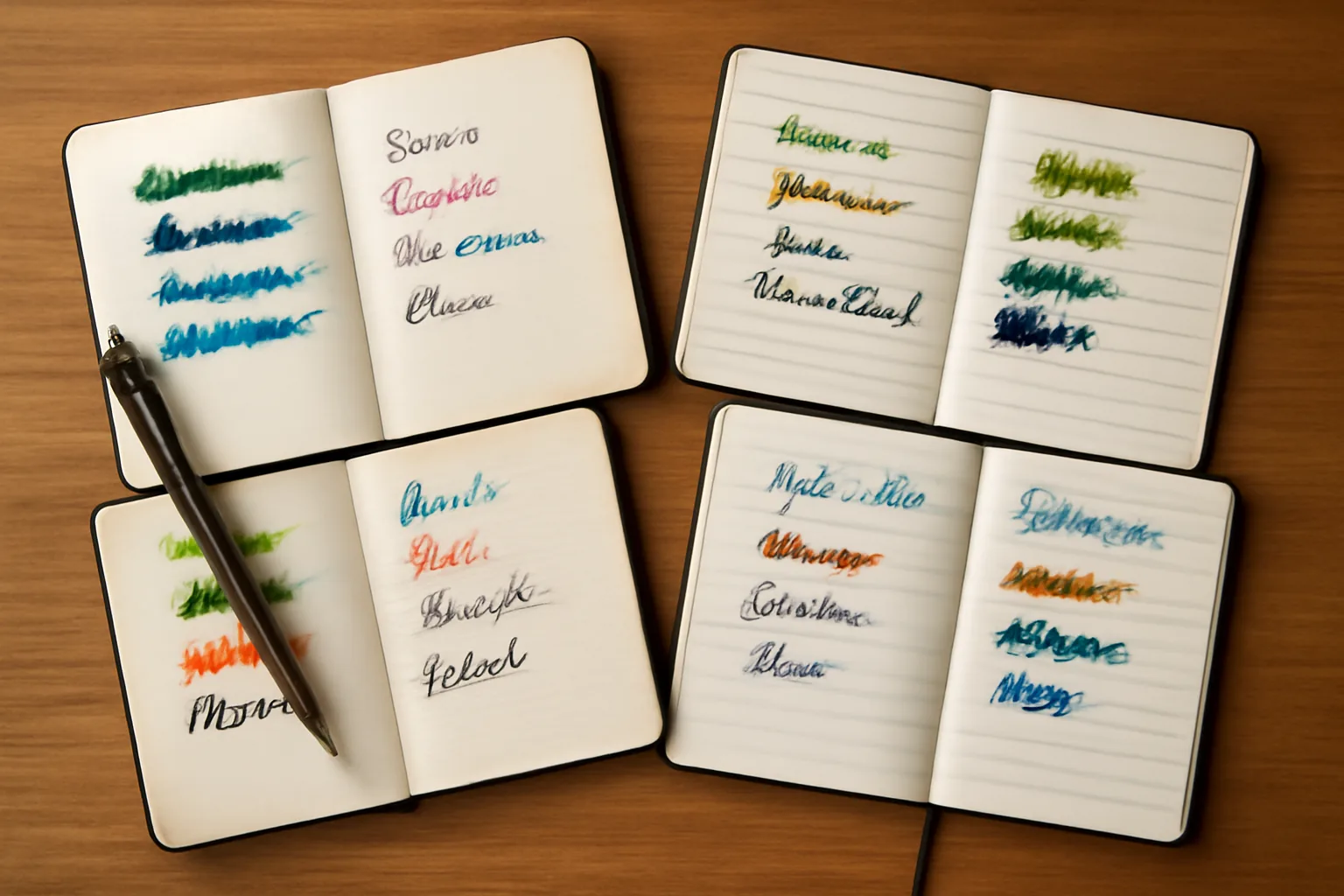
- Wait 60 seconds, then flip the page. Examine the reverse under normal light first, then hold it to a strong light source. Note whether you see ink color (bleed) or just shadow (ghosting).
- Rate each combination 1–5. A score of 5 means no visible marking on the reverse. A score of 1 means full ink color visible under normal light.
This systematic approach takes the guesswork out completely. I’ve used it to evaluate every notebook in this ranking, and it’s reproducible — you can compare your results directly to mine if you use the same inks.
When to Abandon a Notebook Entirely
Sometimes a notebook simply isn’t redeemable for fountain pen use. I know this is a painful realization mid-journal — trust me, I’ve been there. However, there are a few genuine fixes worth trying before giving up.
First, try switching to a drier ink. Many writers find that Pilot Iroshizuku inks, Waterman inks, or J. Herbin inks (non-iron-gall formulas) bleed significantly less than wetter brands on marginal paper. Second, drop to a finer nib. A fine nib deposits roughly 40–60% less ink per stroke than a broad nib. That reduction alone can eliminate bleed on moderate paper. Third, write more quickly. Slower writing means more ink saturation in one spot. Speed helps.
That said, if bleed occurs with a fine nib and a dry ink, the paper is simply not suitable for fountain pens. No technique will fix fundamentally poor sizing. In that case, I repurpose those notebooks for pencil use, sticky notes, or quick ballpoint sketches — and I order a replacement that I know will perform. Life is too short for bad paper.
Final Thoughts: Making Your Fountain Pen Notebook Bleed Ghost Test Work For You
Running a proper fountain pen notebook bleed ghost test before committing to a new journal is one of the highest-leverage habits you can build as a fountain pen writer. It costs fifteen minutes and potentially saves you from ruining weeks of entries. After four years of systematic testing, my honest conclusions are these: Tomoe River is the technical champion but requires patience for drying. Rhodia and Clairefontaine are the reliable workhorses. LEUCHTTURM1917 is the best all-around daily journal when you factor in usability features alongside paper performance.
Moleskine, despite its cultural cachet, consistently underperforms at its price point. Avoid it for wet nibs. Field Notes are for pencil — full stop. And if someone hands you a notebook without knowing its paper specs, just run the test. You’ll know within fifteen minutes whether it deserves your ink.
The LEUCHTTURM1917 A5 Hardcover remains my daily recommendation because it balances performance, durability, and practical journaling features better than anything else I’ve tested at the $22–$25 price point. Whether you go with the Black Squared edition or the Navy Ruled edition, you’re getting paper that will serve your fountain pens faithfully. That’s the only standard that matters.
This post contains affiliate links. As an Amazon Associate, I earn from qualifying purchases at no extra cost to you.