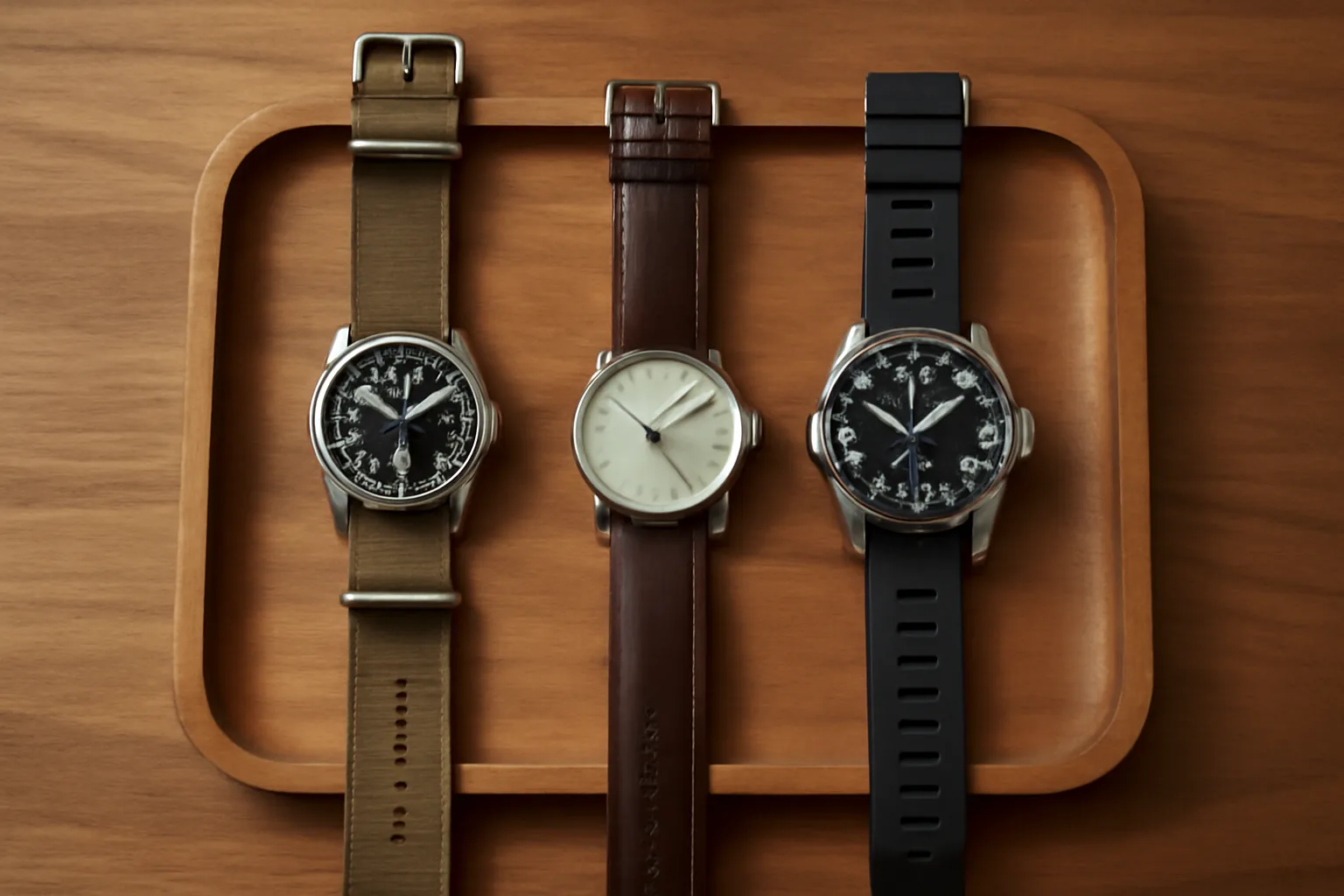
I’ve owned exactly one watch strap that made me feel genuinely stupid. It was a gorgeous cognac leather band on a dive watch I wore kayaking in the Chesapeake. By the time I paddled back to shore, the strap had absorbed so much water it felt like wet cardboard against my wrist. The buckle had left a rust shadow on the leather. One afternoon, completely ruined. That moment crystallized something I now tell every collector who asks about the NATO vs leather vs rubber watch strap debate: the “best” strap doesn’t exist in the abstract. The best strap is the one that’s right for what you’re actually doing today.
I’ve been collecting watches for about fourteen years. Over that time, I’ve put straps through real conditions — saltwater, boardrooms, hiking trails, late nights at jazz clubs, and long transatlantic flights. I’ve tried cheap nylon from gas stations and expensive cordovan from bespoke makers in London. I’ve ruined things. I’ve also found combinations that last years without a complaint. What follows is everything I’ve learned, organized so you can make a confident decision the next time you’re staring at a drawer full of straps wondering which one to grab.
Understanding the Three Core Strap Materials
Before you can match a strap to an occasion, you need to understand what each material actually does — not just what it looks like. Most strap marketing leans heavily on aesthetics. That’s backwards. Start with function, then worry about style.
NATO Straps: Nylon Built for Punishment
NATO straps were standardized by the British Ministry of Defence in 1973 under NATO Stock Number 6645-99-130-9087. That specification matters because it tells you exactly what this strap was designed to do: survive military field conditions. The original spec called for a single piece of woven nylon, threaded under the watch case so the watch stays on your wrist even if a spring bar fails. That design detail has saved more than a few watches from concrete floors.
Nylon is inherently moisture-resistant, quick-drying, and machine-washable. A quality NATO strap costs anywhere from $8 to $50. Most 20mm options weigh under 20 grams. For everyday wear and active use, nothing beats the practicality-to-cost ratio. However, nylon does look casual. It reads sporty, not polished. That’s a design choice, not a flaw — but it does limit where you can wear it without looking mismatched.
Leather Straps: The Dressier Option With Real Limitations
Leather is the traditional choice for dress watches. Full-grain vegetable-tanned leather from makers like Hirsch or Jean Rousseau develops a patina over time. That patina is part of the appeal. A well-worn leather strap tells a story. For formal occasions — a wedding, a business presentation, a dinner where the tablecloth costs more than your meal — leather is the right call aesthetically.
Here’s the honest limitation: leather and moisture are genuinely incompatible. Sweat breaks down the interior stitching over time. Submersion ruins the structure almost immediately. The Horween Chromexcel leather I used on a Seiko SKX007 looked incredible for about eight months. Then I wore it through a summer hike in Virginia. The stitching separated near the buckle end. I replaced it within the week. Leather straps in the $30–$150 range require real care: conditioning every 4–6 weeks, storing away from direct sunlight, and keeping them away from water whenever possible.
Rubber Straps: The Specialist’s Tool
Rubber — specifically vulcanized rubber or FKM fluoroelastomer — is engineered for water. ISO 6425 is the international standard for dive watches, and it specifies a minimum water resistance of 100 meters. Most dive-rated rubber straps are designed to complement watches built to that standard or beyond. FKM rubber, used by manufacturers like Seiko, Tudor, and aftermarket makers like Horus Straps, resists UV degradation, chlorine, and saltwater far better than standard silicone.
Rubber straps typically run $20–$120 for aftermarket options, and they’re almost zero-maintenance. Rinse with fresh water, air dry, done. The tradeoff is comfort in heat. Rubber traps warmth against the skin more than nylon does. In summer, a rubber strap can feel stifling after a few hours. For diving, surfing, or any genuine water activity, it’s unbeatable. For daily wear in warm climates, it depends on your heat tolerance.
Matching NATO vs Leather vs Rubber Watch Strap to Real Occasions
This is where the practical framework lives. I organize my own rotation around four life contexts: active/outdoor, casual daily, business professional, and formal. Each calls for a different material — sometimes a different strap entirely.
Active and Outdoor Use
For hiking, kayaking, cycling, or gym use, choose NATO or rubber. Between the two, NATO wins for general outdoor use because it breathes better and dries in under 30 minutes after soaking. Rubber wins for water sports specifically. I keep a grey NATO on my Hamilton Khaki Field whenever I’m spending a weekend outdoors. It’s been through mud, rain, campfire smoke, and a canoe capsize. One cold rinse and it’s ready for Monday.
Casual Daily Wear
This is where NATO straps really shine. They’re low-maintenance, comfortable, and increasingly accepted in casual workplaces. A solid-color NATO in navy, olive, or black reads clean without effort. For casual daily wear, I rotate between two or three NATO straps per watch. Total cost per rotation: under $75. That’s remarkable value for a collection that covers most of my waking hours.
Leather works beautifully for casual daily wear as long as you’re not sweating heavily or working outdoors. A tan leather strap on a simple field watch hits a sweet spot between dressed-up and relaxed. Specifically, I love this combination in fall and winter when temperatures are cooler and sweating isn’t an issue.
Business Professional Settings
Leather is the default here, and for good reason. A black or dark brown leather strap reads polished and intentional. For meetings, presentations, or client-facing work, a dress leather strap signals that you’ve thought about how you present yourself. That said, a well-chosen NATO in a solid muted color can work in creative or tech industries where dress codes are less rigid. In my experience, a clean black NATO on a minimalist watch passes without comment in most modern offices.
Formal Occasions
Leather only. Full stop. Black tie, weddings, gallery openings — if the occasion has a dress code above “smart casual,” the strap should be fine leather in black or dark cordovan. A NATO strap at a black-tie event looks like you forgot to change. Rubber looks like you’re prepping for a triathlon. I keep a dedicated crocodile-embossed black leather strap that I use maybe six times a year. It costs $65 and has lasted nine years because I only deploy it when conditions are perfect.
The Strap I Reach for Most: BluShark Original Collection
After years of testing, one NATO strap has become my consistent recommendation for anyone building their first rotation: the BluShark Original Collection Military-Style Waterproof Watch Strap. I’ve owned three of these across different colors over the past four years. They’ve earned their place through consistent performance, not marketing.
BluShark uses a tightly woven nylon that holds its shape through repeated washing. The brushed hardware finish on the buckle resists corrosion and doesn’t catch light awkwardly under fluorescent office lighting. At 20mm, it fits my Hamilton Khaki Field, my Orient Bambino, and my Seiko SPB143 without any fitment issues. The strap sits flat against the wrist — no curling, no bunching — which matters more than people realize for all-day comfort.
I learned this the hard way with a cheaper NATO that arrived with a hollow buckle and nylon that pilled within six weeks. The BluShark, by comparison, looks essentially the same after two years of weekly wear. The price point hovers around $30–$35, which is entirely reasonable for the build quality. For someone who wants one reliable NATO before expanding into other materials, this is the one I’d hand them.
A Solid Budget Alternative
If you’re not ready to spend $30 on a strap experiment, the Archer Watch Straps Classic Military Style Nylon Band in Black/Gray at 20mm is a genuinely honest alternative. Archer uses a slightly thinner nylon weave, which some people actually prefer for its lower-profile feel under a shirt cuff. The hardware is serviceable. I’ve gifted Archer straps to friends who were curious about NATOs and didn’t want to commit to a higher price point. None of them complained, and several came back asking about upgrading to BluShark later.
Strap Care, Spring Bar Safety, and When to Ask for Help
Changing a strap is a straightforward process, but there are moments where a pro is the right call. Let me be specific about both.
DIY Strap Changes: What You Need
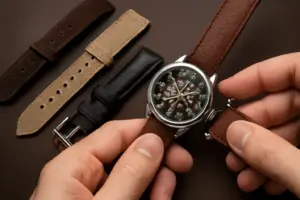
A proper spring bar tool costs $8–$20 and is worth every cent. The forked end slots between the lug and the strap to depress the spring bar without scratching the case. I use a Bergeon-style tool — the same type watchmakers carry. Do not use a knife blade or a flathead screwdriver. I watched a friend scratch a beautiful Tudor Black Bay lug because he improvised. That scratch costs $150–$200 to buff out professionally. The tool pays for itself on the first use.
Spring bars themselves are consumable parts. Replace them every 12–18 months if you swap straps frequently. Aftermarket spring bars cost about $1–$3 each for quality options. Failing spring bars are the number-one cause of watches falling off wrists. A NATO’s design mitigates this risk because the strap runs under the case — the watch stays on your wrist even if both spring bars fail simultaneously. That’s the structural safety advantage leather and rubber straps can’t match.
When to Call a Watchmaker
If your watch has integrated lugs — the kind where the bracelet curves seamlessly into the case — do not attempt a strap change without proper training. Integrated lug systems on watches like the Rolex Datejust or certain Grand Seiko models require specific tools and case knowledge. A slip can damage the lug channel permanently. Take it to a certified watchmaker. Budget $20–$40 for a professional strap swap on a complicated case. That’s not wasted money — it’s protecting a $500–$5,000 investment.
Final Thoughts on the NATO vs Leather vs Rubber Watch Strap Decision
Here’s the honest summary: most collectors need at least two of the three materials. A NATO or rubber for active and casual use, leather for anything requiring polish. If I could only keep one, I’d keep NATO — the versatility, durability, and price make it the most practical choice for the widest range of daily life. If I could keep two, I’d add leather for the occasions that demand it.
The NATO vs leather vs rubber watch strap question doesn’t have one right answer. However, it does have a clear framework. Know your occasion, know your material’s limitations, and invest in quality within whatever budget you’re working with. A $35 BluShark NATO cared for properly will outlast a $15 leather strap worn without thought every time.
As a result, the best thing you can do for your watch collection isn’t buying another timepiece. It’s building a small, deliberate strap rotation that handles every context your life actually throws at you. Start with one great NATO. Add leather when you need it. Consider rubber when water becomes part of the picture. That’s the whole playbook — and it works.
This post contains affiliate links. As an Amazon Associate, I earn from qualifying purchases at no extra cost to you.